Beyond the Loom: The Craft of Finishing a Handmade Rug
We often think of the loom as where the real craftsmanship happens.
The steady rhythm of weaving. The pattern slowly taking shape. The skill and patience required to bring a design to life, knot by knot.
But what happens after a rug comes off the loom is just as important — and far less often seen.
Because in many ways, the rug isn’t truly finished at all.
If you’ve ever browsed our collections or visited our showroom, you’ll know that every rug we source is chosen for its quality, character and craftsmanship. You can browse our latest hand-knotted rug collections to see how these pieces come to life in the home.
When the weaving ends, the work continues
Once a rug is cut from the loom, it’s technically complete — but not yet ready for a home.
The surface can feel slightly uneven. The pile may sit higher in places. The edges aren’t fully refined. What you have at this stage is the structure of the rug, but not its final finish.
This is where the next stage of craftsmanship begins.
If you’re interested in the full journey, we’ve explored this in more detail in our blog on how long it takes to make a handmade rug, where each stage plays a part in the final result.
Washing and settling the fibres
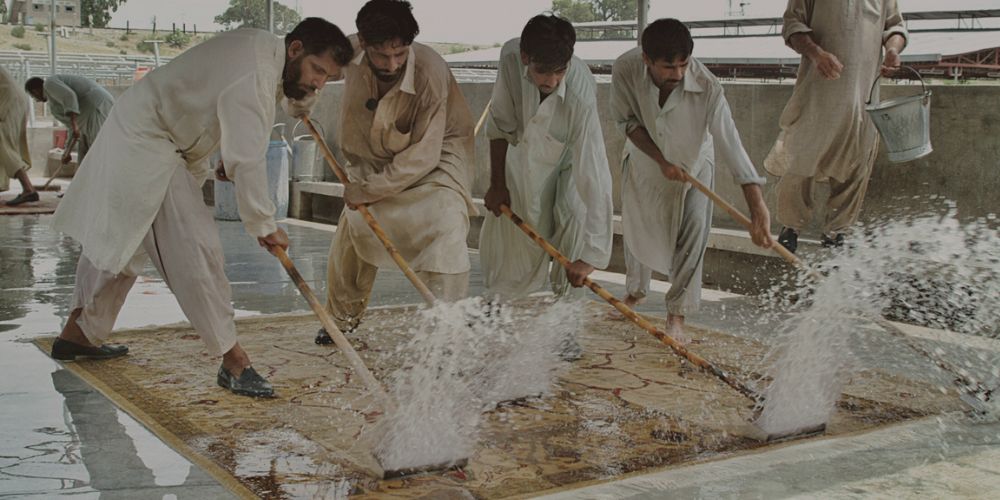
The first step is usually a thorough wash — often done by hand, using water to clean and settle the fibres.
This removes dust from the weaving process and allows the colours to come through more clearly, softening slightly and gaining depth.
It’s a subtle shift, but an important one. The rug begins to feel more cohesive, more balanced.

Drying and setting the structure
After washing, the rug is laid out to dry.
This stage allows the fibres to settle and the structure to stabilise. It’s also where the character of the rug begins to emerge more clearly — the colours softening and the texture becoming more apparent.
Often done outdoors, this part of the process adds a quiet sense of place to the making of each piece.

The finishing touch
One of the most fascinating parts of the process happens right at the end.
After a rug comes off the loom, the surface isn’t perfectly even. The pile can sit slightly higher in places, reflecting the natural variation of the weaving process.
So the rug is carefully finished by hand — gently shaved to create a smooth, even surface.
This was filmed by Alex on one of his recent sourcing trips, in Pakistan, where many of our Afghan rugs are hand finished.
And we have to say, we find this part of the process incredibly satisfying to watch.
It’s slow, precise, and almost rhythmic. As the blade moves across the rug, you can actually see everything coming together — the pattern becoming clearer, the surface softening, the whole piece starting to feel more refined.
It’s a quiet moment in the making of a rug, but such an important one.

Clipping and refining the detail
Once the surface has been evened, further refinement begins.
Clipping allows small variations to be corrected and patterns to be sharpened. It’s a careful, considered process — one that requires experience and a close eye for detail.
At this stage, the rug begins to feel more defined, with each element of the design becoming clearer.

Edges, fringes and final details
The final stage is all about the details.
Edges are secured. Fringes are finished. Any remaining inconsistencies are corrected by hand.
These finishing touches ensure the rug is not only beautiful, but durable — ready to be used and lived with.

A different kind of craftsmanship
We often associate craftsmanship with what happens on the loom — and rightly so.
But the finishing process is what brings everything together.
It refines what’s already been created. It sharpens the pattern, softens the surface, and ensures the rug feels complete — both visually and underfoot.
It’s the final, quiet stage of the process. Less visible, perhaps — but no less important.
And it’s what allows each rug to leave the loom not just complete, but ready to become part of a home.


Written by Alex Rees