Knot count, explained: what the numbers really mean in handmade rugs

In the world of handmade rugs, few phrases are tossed around as confidently as knot count.
It sounds pleasingly precise — a neat shorthand for quality.
But like all good craft terms, there’s far more woven into it than a simple number suggests.
Think of knot count as the weaver’s handwriting:
it tells you something about finesse and intent…
…but not everything about the beauty, durability, or soul of the rug.
What is knot count, exactly?
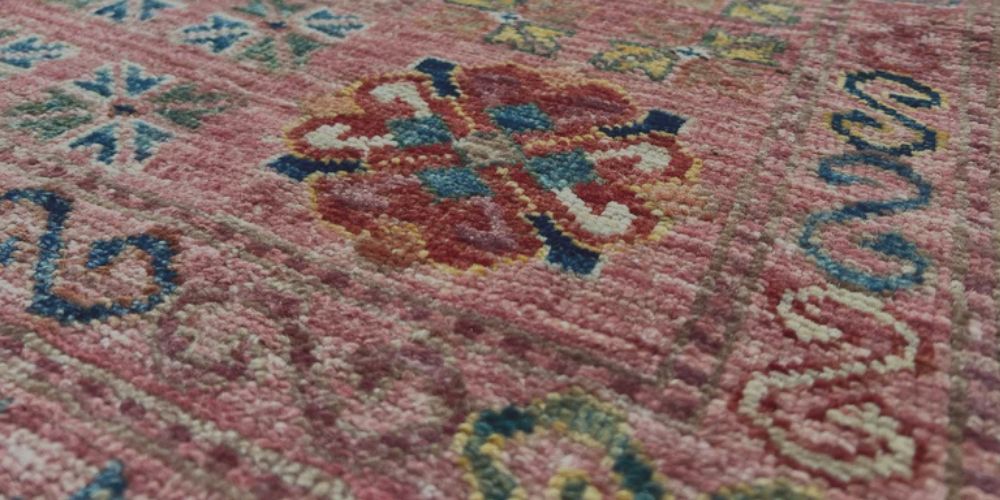
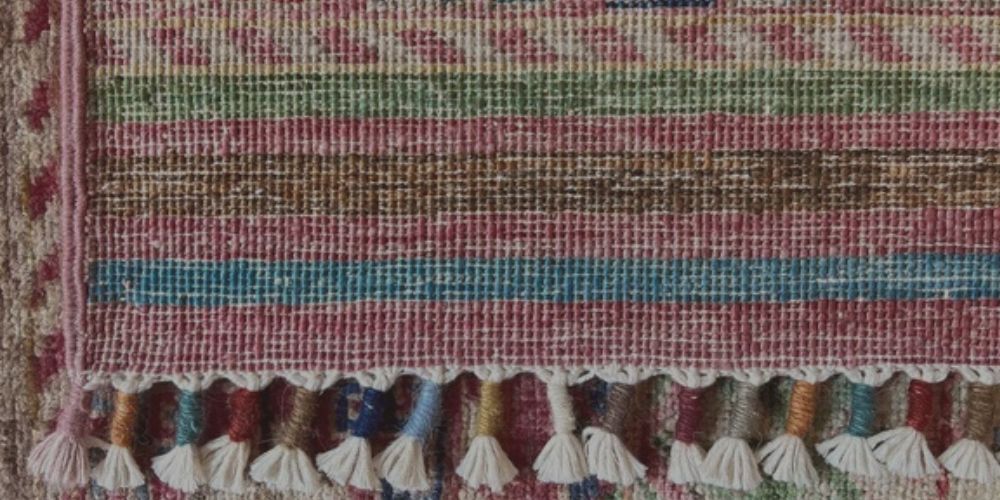
In a hand-knotted rug, every knot is individually tied onto the vertical warps, row by row, creating a pile.
Knot count is simply the density of those knots measured within a set area.
Most commonly you’ll see:
- KPSI (knots per square inch)
- or the metric equivalent (knots per square centimetre)
To take a reading:
- Count the knots across one inch horizontally
- Count the knots down one inch vertically
- Multiply the two numbers
A compact 8 × 9 grid, for example, yields 72 KPSI.
Higher counts allow for more intricate drawing and smoother curves;
lower counts favour bolder, more graphic geometry.

Why knot count isn’t the whole story
Knot count is about detail — not necessarily about what makes a rug "better".
A masterfully balanced design in a medium knot count can be far more compelling than a fussy pattern forced into ultra-fine density.
The character of the wool, the quality of the dyes, the deftness of the drawing, the evenness of the weave, and the overall handle of the rug all matter just as much.
Wool, for instance, is celebrated for domestic use because it is:
- naturally resilient
- pleasantly springy underfoot
- commendably stain-resistant
It wears with grace and, crucially for family life, can be properly cleaned and professionally repaired in the years ahead.

Wool, silk, and how materials shape the weave
Material choices influence both knot count and the feel of the finished rug.
Wool
- Durable and forgiving
- Warm, soft, and practical
- Ideal for everyday living spaces
Silk
- Finer fibres
- Capable of carrying exceptional detail
- Creates a luminous sheen and refined finish
A silk rug often has a higher knot count and a smooth, almost liquid handle.
That said, silk is more delicate and generally better suited to quieter rooms, whereas a good wool rug will take the hall, the sitting room, and the rhythm of everyday life in its stride.

When knot count doesn’t apply
Not all handmade rugs are knotted.
Flatweaves
- No pile, no knots
- Created through interlacing threads
- Lightweight, versatile, often reversible
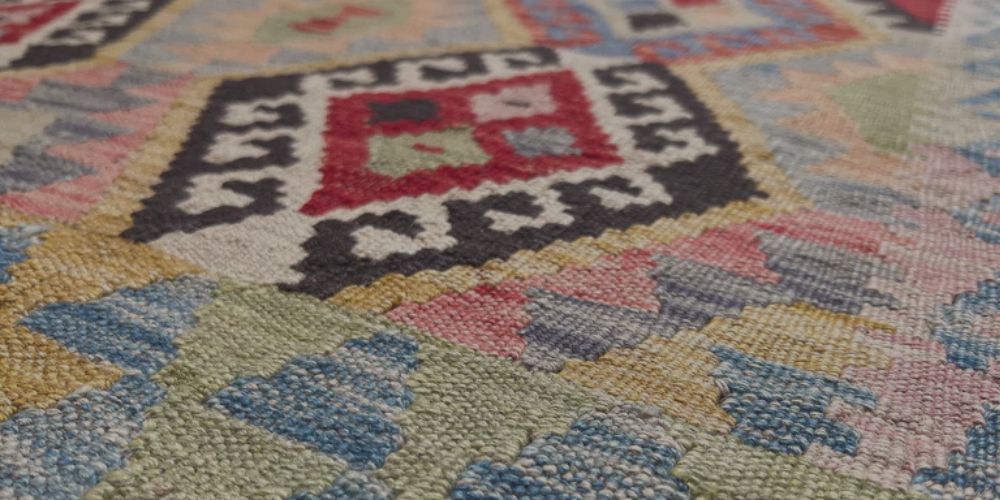
Our flatweaves are Kilim rugs — a traditional handwoven style — known for:
- their flat, tightly woven structure
- bold geometric patterns
- a lighter, more relaxed feel underfoot
They work beautifully in layered interiors, on wooden floors, or in spaces where you want texture without pile.
Hand-tufted rugs
- Yarn is punched into a backing fabric and secured with adhesive
While they can achieve detailed designs, they do not offer the same longevity or repairability as hand-knotted rugs.
For that reason, we choose not to source them.
Instead, we focus on hand-crafted rugs — primarily hand-knotted pieces, alongside carefully sourced flatweaves — chosen for their quality, longevity, and ability to be lived with and, if ever required, repaired and enjoyed for many years.

How to count knots at home
If you’re curious, you can measure knot count yourself:
- Find a ruler or tape measure with a clear inch or centimetre scale
- Part the pile gently to expose the grid of individual knots
- Count the knots across one measured inch
- Count the knots down the same distance
- Multiply the two figures (e.g. 8 × 9 = 72 KPSI)
Repeat in a couple of places to average out any local variation —
handmade is delightfully human.
The look, the life, the feel
A higher knot count can carry exquisite curvilinear drawing —
think fine floral medallions with delicate tendrils.
A moderate count often suits:
- tribal geometry
- relaxed, village character
- more open, breathable designs
For real homes:
- A hand-knotted wool rug of moderate density is a superb, long-lived choice
- A finer weave can act as a quieter, more detailed focal point
And importantly, hand-knotted rugs can be repaired —
a reassuring thought if life happens to your favourite piece.
Common myths, gently unpicked
“Higher knot count means better rug.”
Not necessarily — it means finer potential detail.
“Flatweaves have low knot counts.”
Flatweaves have no knot count — there are no knots to measure.
“Tufted rugs have high knot counts.”
They aren’t knotted at all; the metric doesn’t apply.
“Silk is always best.”
Beautiful, yes — but wool is often the more practical and enduring choice.
From the loom to Petworth
Since 2001, our founder Alex Rees has travelled to weaving regions to select handmade rugs directly from artisans.
On buying trips, the number on the tag is never the sole arbiter.
We look for:
- good wool
- balanced colour
- confident drawing
- honest workmanship
The qualities that make a rug sing in a real home.
Our Modern Classic eye favours pieces where heritage patterns are reimagined with fresh colour, so they feel at ease in a Sussex cottage or a smart townhouse alike.
Choosing with confidence
Use knot count as one lens, not the final verdict.
Handle the rug, study the design, ask about the fibres, and consider where it will live.
Whether you’re drawn to:
- the crisp geometry of a hand-knotted wool runner
- the tactile structure of a Kilim flatweave
- or the refined detail of a finer weave
…the right piece will feel compelling the moment you unroll it.
And if you’d like to compare different densities side by side, we’d be delighted to show you around the showroom and talk you through different pieces in person.

Written by Alex Rees